September 15, 2026·All insights
How Often Should Creators Be Posting to Grow Faster?
Creators are constantly told to post more. FAMA analyzed seven weeks of posting activity and follower growth across hundreds of Caribbean creator accounts to see whether the data supports that advice.
“Post consistently.”
It is one of the most common recommendations given to creators trying to build an audience online. The reasoning is intuitive: publishing more often creates more opportunities for content to be seen, shared and discovered.
But how closely is posting frequency actually related to audience growth?
To examine that question, FAMA analyzed seven weeks of public posting activity and follower growth across 249 Instagram accounts and 233 TikTok accounts belonging to Caribbean creators.
For each platform, creators were grouped according to their average weekly increase in publicly visible posts or videos. We then compared follower growth across those posting-frequency groups.
The results point to an important distinction. On Instagram, higher posting frequency was associated with progressively higher follower growth. On TikTok, growth also increased among more active creators, but only up to a point. The highest-volume TikTok accounts did not record the strongest growth.
Posting frequency appears to matter, but the relationship is not the same across platforms.
Instagram showed a clear relationship between posting frequency and growth
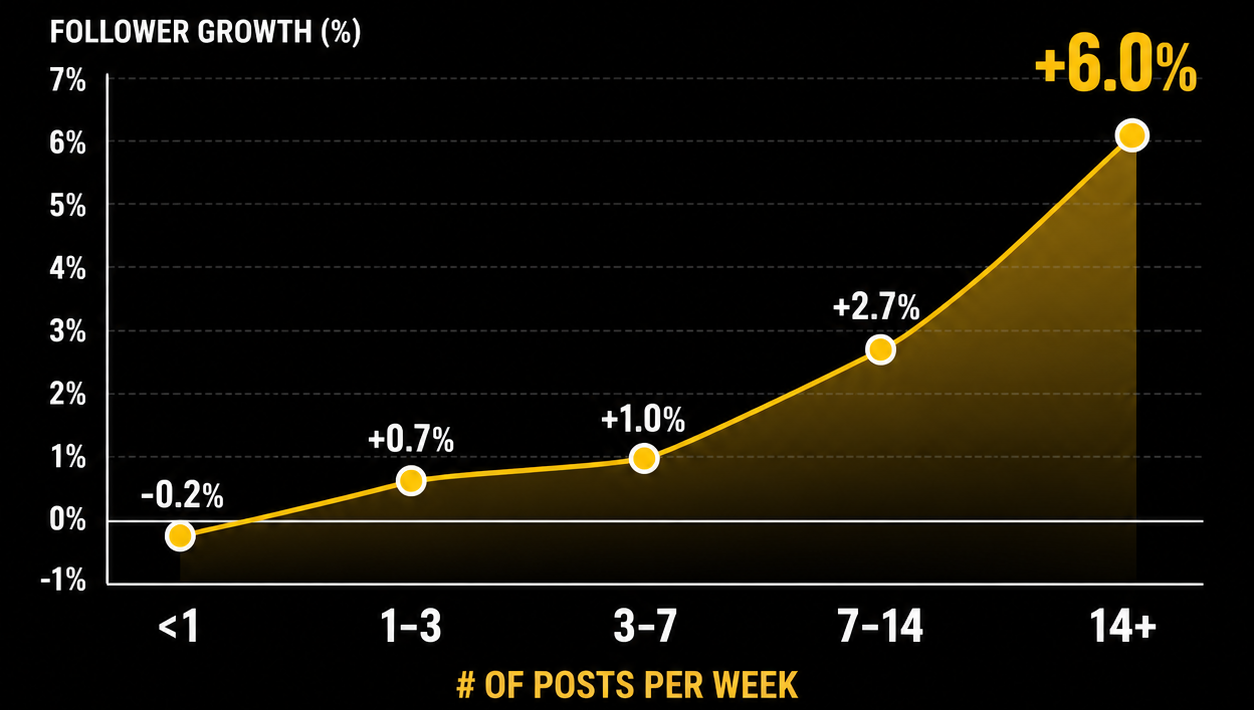
Among the Instagram accounts analyzed, average follower growth increased at every successive level of posting frequency.
Creators averaging fewer than one new public post per week recorded essentially no audience growth, with average follower growth of -0.2% over the seven weeks.
Growth was higher among creators posting more regularly. Accounts averaging 1–3 posts per week grew by 0.7%, while those averaging 3–7 posts per week grew by 1.0%.
The difference became more pronounced among the most active creators. Accounts averaging 7–14 posts per week grew by 2.7%, while creators averaging 14 or more posts per week recorded the highest average follower growth at 6.0%.
Figure 1. Average follower growth by Instagram posting frequency
The Instagram results suggest that posting frequency may matter most when it is part of a broader capacity to produce content consistently at scale. Creators publishing at high volume are not simply posting more often. They may also have stronger production systems, greater momentum, established audiences, or content formats that allow them to create and distribute more efficiently.
Higher posting frequency may also increase the number of opportunities a creator has to reach new audiences. More posts mean more chances for content to be recommended, shared, or discovered, even if individual posts perform differently.
For creators, the finding is not necessarily that everyone should aim for 14 or more posts per week. Rather, the data suggests that frequent publishing can be an important part of Instagram growth when creators can sustain that output effectively.
TikTok showed a different pattern
TikTok did not show the same steady relationship between posting frequency and follower growth.
Creators averaging fewer than one new video per week recorded approximately 0.0% follower growth over the seven weeks. Average growth increased to 0.8% among creators posting 1–3 times per week and 1.3% among those posting 3–7 times per week.
The largest increase appeared in the next group. Creators averaging 7–14 TikToks per week grew by 6.0%, the highest average growth observed across the TikTok posting-frequency groups.
However, that pattern did not continue among the most active accounts. Creators averaging 14 or more TikToks per week grew by 1.4%, substantially below the 7–14 group.
Figure 2. Average follower growth by TikTok posting frequency
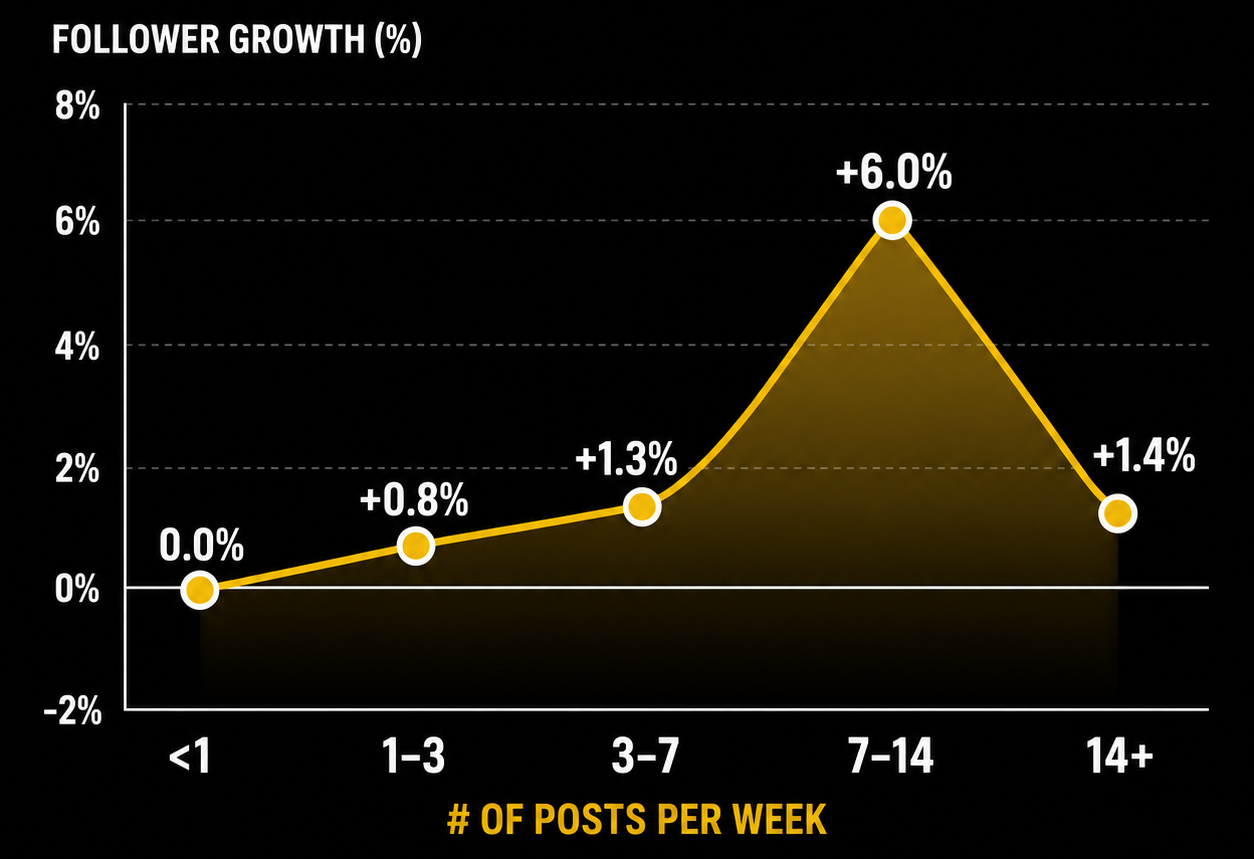
This distinction is important. Unlike Instagram, where average follower growth increased at every successive level of posting frequency, TikTok showed a non-linear relationship. Growth increased through the 7–14 posts-per-week group before declining among creators posting at the highest frequency.
The result should not be interpreted as evidence that posting 7–14 times per week is an optimal TikTok schedule. The analysis does not account for differences in content quality, format, creator size, category or the influence of individual high-performing videos. The observation period is also relatively short.
What the data does show is that higher posting volume was not consistently associated with higher follower growth on TikTok. Within the accounts studied, creators publishing 14 or more times per week did not grow faster simply because they were producing the most content.
Posting frequency appears to work differently across platforms
Taken together, the Instagram and TikTok results challenge the idea that there is a single posting strategy creators can apply across platforms.
On both platforms, the least-active creators experienced little to no average follower growth during the period studied. Beyond that point, however, the patterns diverged.
On Instagram, follower growth increased progressively as posting frequency increased, with the highest average growth observed among creators publishing 14 or more times per week.
On TikTok, the strongest average growth occurred among creators publishing 7–14 times per week, while the highest-volume group recorded substantially lower growth.
These findings do not establish how often an individual creator should post. Instead, they suggest that the relationship between content volume and audience growth may depend on the platform.
Posting more creates additional opportunities for discovery, but additional content does not necessarily produce proportional returns. Content format, quality, audience response, existing momentum and the performance of individual posts remain important parts of the growth equation.
So, should creators post more?
The data provides some support for one part of the conventional advice: consistency matters.
Creators posting very little on either Instagram or TikTok experienced little to no average follower growth during the seven weeks studied. More active groups generally performed better.
But the results provide much less support for a second assumption: that continually increasing posting volume will necessarily produce continually increasing growth.
That pattern was visible on Instagram during the period we studied. It was not visible on TikTok.
For creators, the practical takeaway is not to pursue a particular number of posts simply because it performed well for one group in this analysis. A sustainable publishing strategy also has to account for the quality of the content being produced, the audience it is intended to reach and how that content performs on each platform.
There is also a constraint that posting-frequency targets often overlook: creators have to produce the content.
Increasing output may be valuable when a creator has the ideas, workflow and resources to maintain it. Increasing output at the expense of quality, originality or sustainability is a different proposition entirely.
Post consistently. But don't assume that more is always better.
The strongest publishing strategy may not be the one that produces the most content. It may be the one that creates enough opportunities for discovery while maintaining the quality and relevance that give audiences a reason to follow.