September 7, 2026·All insights
We Analyzed 40,000+ Comments From Caribbean Creators. Here’s What We Found.
FAMA analyzed YouTube comments from 123 Caribbean creators to understand what audiences are actually doing beneath the videos, from sharing experiences and discussing products to giving advice and expressing Caribbean identity.
By FAMA Research Team · September 7, 2026

Followers tell us how large a creator’s audience is. Views tell us how much attention a video received.
But neither tells us much about the people behind those numbers.
What are viewers actually saying? Are they asking questions, sharing their experiences, discussing products or expressing where they are from? And how different can one creator’s audience be from another?
To explore those questions, FAMA analyzed 40,212 top-level YouTube comments from 123 Caribbean creators, using up to 12 recent eligible videos per creator.
The results reveal something conventional creator metrics can easily miss: Caribbean creator audiences are not all engaging in the same way.
Most comments were positive, but audiences did more than show support
The overall tone was strongly favorable. Approximately 60.8% of comments were classified as positive, compared with 17.6% neutral, 13.9% negative, 5.6% mixed and 2.1% unclear.
Praise and support was the largest specific reaction, appearing in 28.7% of comments. Humor or amusement appeared in 13.5%, while 11.8% expressed criticism or disagreement.
But audiences were doing more than reacting.
Approximately 8.9% of comments shared a personal experience, while 8.7% gave advice. Another 7.2% interacted directly with the creator, 7.0% asked a question and 5.2% requested future content.
These percentages may look modest individually, but across more than 40,000 comments, they represent thousands of moments when viewers contributed something of their own.
Someone watching a creator discuss a life experience might respond with a similar story. A viewer watching a tutorial might ask a follow-up question. Others may recommend what the creator should do next or request another video on the subject.
That is a different kind of engagement from a view or like because it requires the audience to enter the conversation.
Key finding: Comment volume tells us that people responded. Comment behavior tells us how.
Nearly 1 in 10 comments contained a commercial signal
Creator influence is often evaluated using follower counts, views and engagement rates. But audiences can also reveal commercial interest directly through what they say.
Across the dataset, approximately 8.4% of comments contained a commercial signal.
These signals included:
Discussion of products or brands
Interest in something featured in the video
Recommendations or purchase intent
Requests for product links or additional information
Sponsorship or advertising references
Questions about price or availability
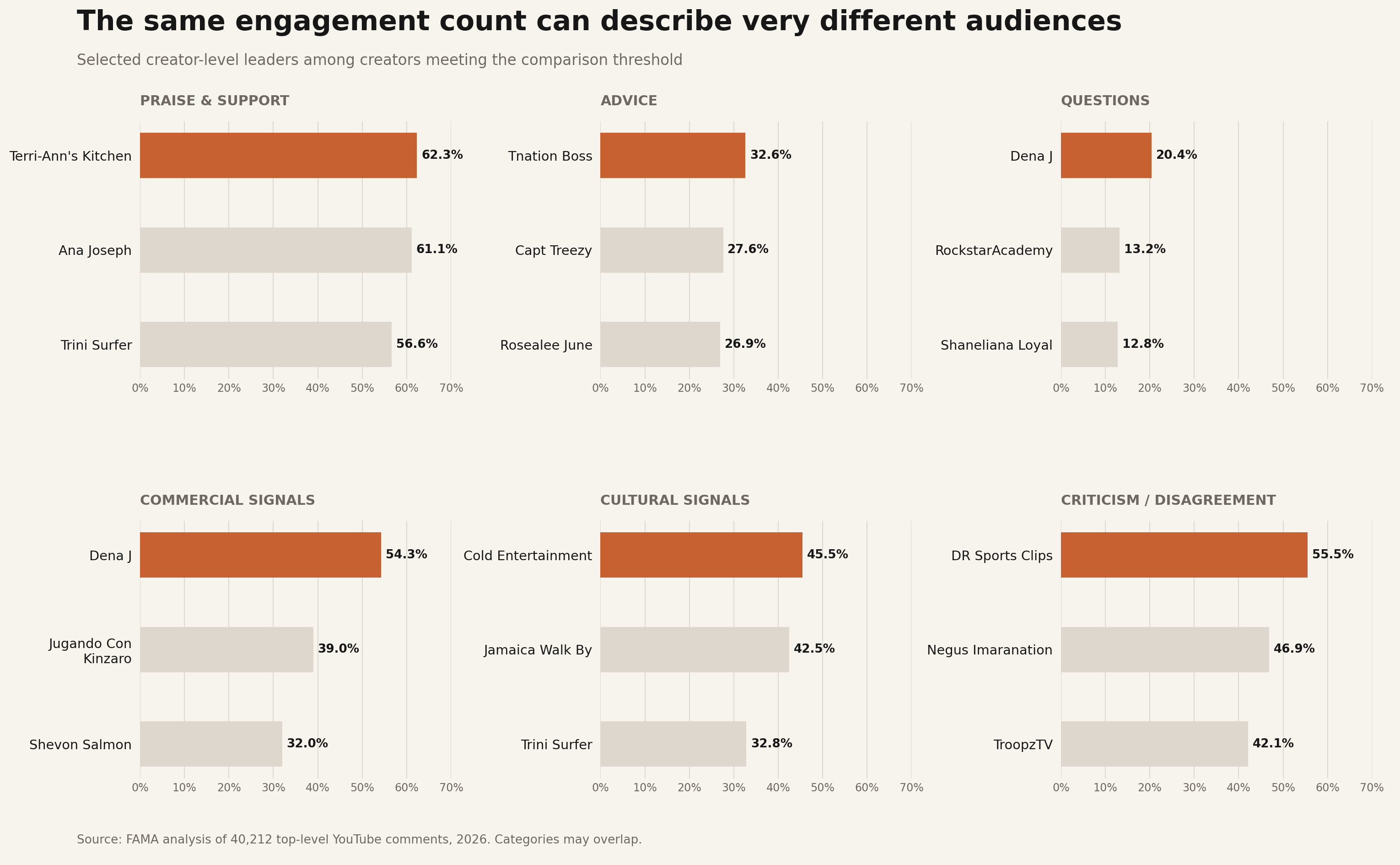
The differences between creators were substantial. Commercial signals appeared in 54.3% of analyzed comments for Dena J, 39.0% for Jugando Con Kinzaro and 32.0% for Shevon Salmon.
This does not mean 54.3% of Dena J’s viewers intended to make a purchase. A commercial signal is broader than purchase intent. But it does tell us something important about the environment surrounding the creator: some audiences naturally discuss products, brands and recommendations far more than others.
For brands evaluating creator partnerships, that behavior provides context that is not visible from audience size alone. A smaller creator whose audience routinely asks about products or seeks recommendations may present a different opportunity from a larger creator with less commercial conversation.
Culture and language shape the conversation
Approximately 1 in 10 comments contained a cultural signal.
We looked for references to Caribbean countries and places, flags and national symbols, language and slang, identity and pride, music, food, traditions, carnival, festivals and diaspora life.
Cultural signals were particularly prominent around several creators. They appeared in 45.5% of analyzed comments for Cold Entertainment, 42.5% for Jamaica Walk By and 32.8% for Trini Surfer.
These comments offer another way to think about creator reach. A Caribbean creator’s audience is not simply a collection of followers distributed across different countries. Comment sections can become places where viewers identify themselves, recognize familiar language, discuss home and maintain connections to Caribbean life from elsewhere in the world.
The languages used across the dataset reinforce that point.
Language classification | Share of comments |
|---|---|
English | 57.9% |
Spanish | 13.9% |
Jamaican Patois | 12.4% |
Haitian Creole | 3.7% |
Mixed or code-switched | 3.4% |
Primarily emojis or symbols | 6.3% |
Although English was the most common language, a substantial share of the conversation happened outside standard English.
Viewers may move between English, Spanish, Haitian Creole, Jamaican Patois and other forms of expression depending on the creator, subject and community. Treating the Caribbean as one homogeneous English-speaking creator market would therefore miss a significant part of the conversation.
Country-level comparisons also produced several early patterns. Haitian creator audiences stood out for support, shared experiences and cultural expression. Audiences around creators from Dominica showed comparatively high levels of advice, questions and criticism, while creators from the Dominican Republic stood out for direct creator interaction.
The Bahamas showed particularly strong commercial conversation, Barbados stood out for cultural signals, and Jamaican creator audiences showed notable levels of both commercial conversation and code-switching.
These findings should not be interpreted as fixed characteristics of audiences from any country. The creators represented, their content categories and the videos sampled all influence the results.
Instead, they point toward a useful question for future analysis: how might Caribbean digital audiences differ across cultural and national contexts?
The same engagement count can describe very different audiences
The creator-level results make those differences especially clear.
Terri-Ann’s Kitchen had one of the most supportive audiences in the analysis, with praise or support appearing in 62.3% of comments. Tnation Boss stood out for viewers giving advice, while questions were especially prominent around Dena J.
Other audiences were shaped more heavily by culture, product conversation or debate.
For DR Sports Clips, 55.5% of analyzed comments contained criticism or disagreement. Negus Imaranation followed at 46.9%, while TroopzTV was at 42.1%.
Those figures may appear purely negative at first. But criticism can also indicate that viewers are deeply engaged with the subject. Sports, politics, current affairs and opinion-driven content naturally invite argument in ways that a cooking tutorial or lifestyle vlog may not.
None of these audience behaviors is automatically better than another. Together, they show why two creators with similar comment totals can have fundamentally different relationships with their audiences.
What this means for creator measurement
A question, product inquiry, personal story and disagreement may each count as one comment, but they signal very different relationships between a creator and their audience.
That context matters in a Caribbean creator economy spanning multiple islands, languages, cultures and diaspora communities. For brands choosing partners and creators seeking to understand their communities, the question is not only whether an audience responds, but how and why they respond.
Audience size shows how many people a creator may reach. Looking more closely at audience behavior helps explain the kind of influence that creator may hold.
About the analysis
FAMA analyzed 40,212 top-level YouTube comments from 123 Caribbean creators. The analysis sampled up to 12 eligible recent videos per creator and classified comments across multiple dimensions, including audience behavior, commercial and cultural signals, language, sentiment and reaction.
Creator-level comparisons were restricted to creators with sufficient video and comment coverage to reduce the influence of very small samples. Creator-authored comments were excluded from creator-level audience analyses.
Categories were not necessarily mutually exclusive. A comment could, for example, contain a cultural reference while also asking the creator a question or discussing a product. Percentages therefore represent the prevalence of individual signals rather than portions of one mutually exclusive whole.
The findings are based on a sample of YouTube comments and should not be interpreted as representative of every viewer, video, creator or the entire Caribbean creator economy. Results may also reflect differences in subject matter, content category, audience size and the videos included.